
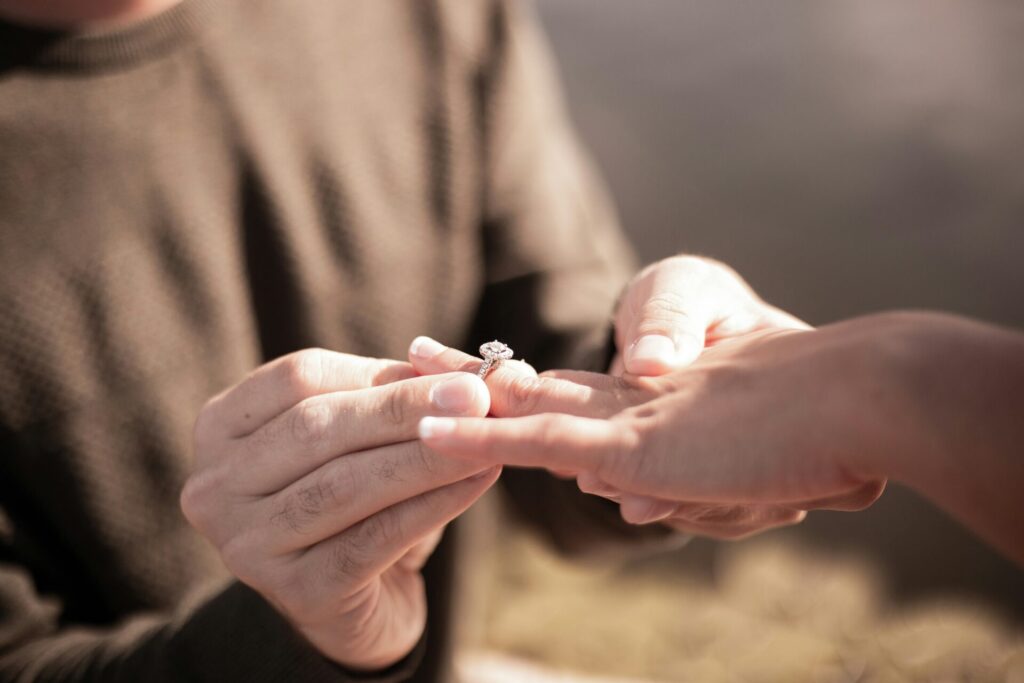
Once you’ve decided that a lab grown diamond engagement ring is the right choice, you’re suddenly faced with hundreds of stones that all look remarkably similar online. Before long, all those carat weights, colour grades, clarity ratings and certificates begin to blur into one, when all you really want is a ring that your partner will cherish.
It’s something that we see every day at Hatton Garden Diamond. Clients arrive who are convinced that they’ve narrowed their choices down to two or three diamonds, only to change their minds once they’ve seen them in-person. The certificate tells part of the story, but it doesn’t tell you how a diamond comes to life when it catches the light or why one stone instantly draws your attention more than another.
Choosing a lab grown diamond engagement ring comes down to understanding which characteristics genuinely affect the way that a diamond looks and where your budget will make the biggest difference. In this guide, we’ll share the advice that our jewellers give to our clients every day and help you to choose a diamond that you’ll love for life.
The Four Cs of Lab Grown Diamond Engagement Rings
Cut, colour, clarity and carat are the internationally-recognised standards that are used to assess a diamond, and they’re invaluable for comparing one lab grown stone with another. Where buyers often get caught out is assuming that they need the highest possible grade in every category. At Hatton Garden Diamond we’d rarely recommend that approach and have always believed that a gem should be judged as a whole; it’s not always the most expensive jewel that catches the eye.
Why Cut Makes the Biggest Difference
If you asked our jewellers to prioritise just one of the Four Cs, almost every one of them would give the same answer: cut.
Carat weight tends to dominate the conversation because it’s easy to compare, it’s also often the first thing that buyers notice. Yet once you start looking at diamonds in person, the cut is usually what separates a beautiful diamond from one that feels rather ordinary.
Whether you’ve chosen a round brilliant, oval or emerald cut, the cut grade refers to how precisely that diamond has been proportioned and polished. Every angle and every facet is carefully calculated to control the way that light enters the stone before reflecting back towards your eye. When those proportions are right, the diamond appears bright and full of fire. If they’re even slightly off, more light escapes through the bottom or sides of the stone, leaving it looking flatter than its certificate might suggest.
We’ve lost count of the number of times we’ve placed two similarly sized diamonds next to each other and watched clients reach for the better-cut stone without even realising why. That’s one of the reasons why we often recommend choosing a cut before increasing the carat weight. A beautifully cut one-carat diamond will usually leave a stronger impression than a larger stone that lacks the same brilliance.
Understanding Diamond Clarity
Every natural and lab grown diamond contains tiny internal characteristics known as inclusions, along with occasional surface blemishes. They’re a natural part of how diamonds form and, in most cases, they’re so small that they’re impossible to see without magnification.
One of the questions that we’re regularly asked is whether an inclusion will be visible. More often than not, the answer is no. Many lab grown diamond engagement rings are considered ‘eye clean’, meaning that any inclusions can only be seen under magnification. To the naked eye, they appear every bit as beautiful as significantly more expensive stones with a higher clarity grade.
That’s why we don’t encourage clients to chase the highest clarity grade simply for the sake of it. If a diamond looks flawless without a jeweller’s loupe, then paying a premium for characteristics that you’ll never actually see doesn’t always represent the best use of your engagement ring budget.
Is Carat Weight as Important as You Think?
Carat sizing refers to a diamond’s weight rather than its physical dimensions. Two one-carat diamonds can appear noticeably different depending on their proportions, cut and shape, which is why focusing on the number alone can sometimes be misleading.
The shape of the diamond can also influence how large or small it appears. Oval, pear and marquise diamonds, for example, tend to create the illusion of a larger centre stone than a round brilliant of the same carat weight. It’s one of the reasons why we always recommend looking at the finished engagement ring rather than simply choosing a larger carat.
Why Diamond Certification Matters
Independent certification is your reassurance that the lab grown diamond engagement ring has been assessed by an unbiased gemmological laboratory. Rather than relying on descriptions such as ‘premium’ or ‘excellent quality’, you’ll have an objective report confirming the diamond’s cut, colour, clarity and carat weight.
At Hatton Garden Diamond, every lab grown diamond is GIA-certified, giving you complete confidence in exactly what you’re buying. It’s also one of the easiest ways to compare two similar diamonds fairly, particularly if you’re deciding between several options.
Certification becomes even more valuable if you’re buying an engagement ring online. A beautiful photograph can only tell you so much, whereas an independent grading report gives you a clear understanding of the diamond’s characteristics before you make your decision.
If you’re unsure how to interpret a certificate, don’t worry. Most of our clients aren’t gemmologists, and we wouldn’t expect them to be. One of the things that we enjoy the most is walking people through the details and helping them to separate the specifications that matter from those that simply look impressive on paper.
Our Advice for Choosing the Right Lab Grown Diamond Engagement Ring
If there’s one piece of advice that we’d give to anyone buying a lab grown diamond engagement ring, it’s to not become too focused on finding the ‘perfect’ one. Some of the most beautiful diamonds that we’ve ever shown clients haven’t been the ones with the highest grades across every category. They’ve been the diamonds that felt balanced; the ones that immediately caught the light, complemented the chosen setting and made people smile the moment that they saw it.
Whether you’re still exploring your options or have already narrowed your search down to a particular style, our jewellers are here to help you find a lab grown diamond engagement ring that feels every bit as special as the occasion it’s chosen for. To find out more, book an appointment with us today and let us help you to find the perfect engagement ring.