
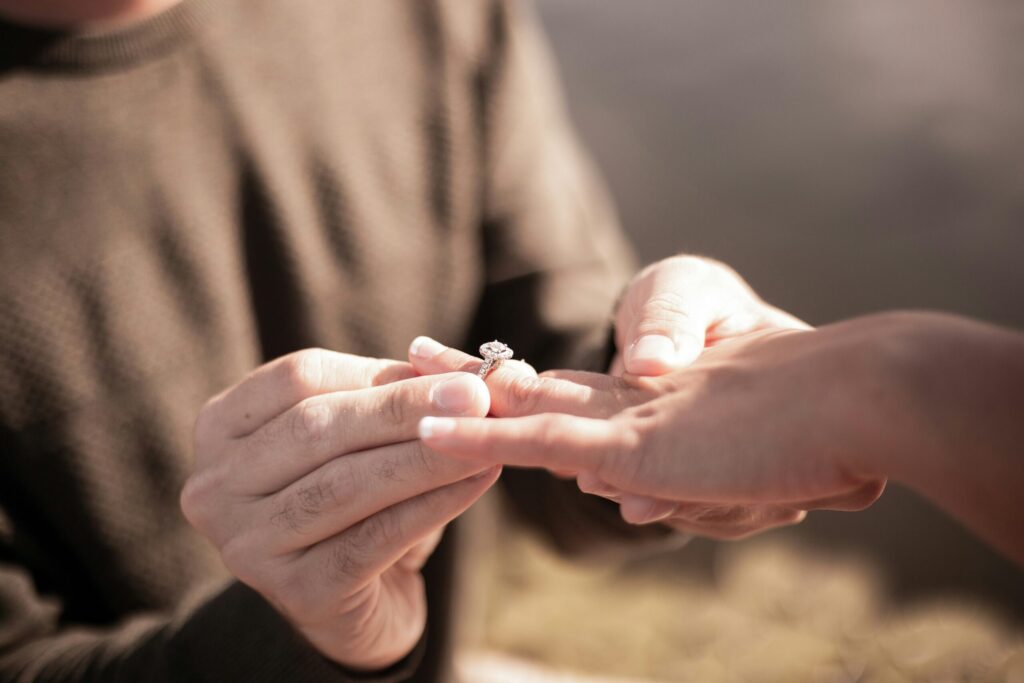
With so many things to decide and arrange prior to becoming engaged, it may seem a little trivial to have to think about which hand and finger is best for your engagement ring. However, it’s worth noting beforehand that there aren’t actually any strict rules dictating where the ring should be worn; so, if your partner naturally favours one hand over the other, then it’s not a problem at all to choose what feels most comfortable, or meaningful.
There are however, some traditions that you may wish to observe when it comes to choosing, and to give you a full picture we’ve gone into these a little more below.
A Very Brief History Of Engagement Rings
It’s believed that the concept of an engagement ring dates back to Ancient Roman times, although the first actual diamond engagement ring is said to have been given to Mary of Burgundy by the amorous Archduke Maximillian of Austria in the late 15th Century.
The giving and receiving of engagement rings represent a promise, a sign of devotion and a symbol of everlasting love that has united couples for centuries. But looking at traditions around the world, it’s clear to see that there’s no particular consensus as to which hand or finger is universally regarded as the best for wearing an engagement ring.
The Left Hand
There seems to be a preference in most Western cultures for engagement rings to be worn on the fourth finger of the left hand (the one next to the little finger or ‘pinkie’). This tradition dates back to Roman times when it was believed that a vein, the Vena Amoris or ‘vein of love’, travelled from this finger directly to the heart, connecting this finger to the biggest symbol of love in the human body.
Such has been the popularity of this belief that the fourth finger of the left hand is now commonly known by many as the ring finger. However, wearing an engagement ring on this finger of the left hand, isn’t a tradition that’s observed all over the world. It isn’t even a belief that extends to all Western cultures.
The Right Hand
Germans, Austrians, Norwegians and Russians would likely frown when seeing an engagement ring anywhere on the left hand, let alone on the ‘ring finger’. They wear engagement rings on the right hand, because their cultures regard the left as unlucky, a viewpoint that likely stems from the Latin translation of ‘left’ which means sinister. Hardly a great sign for the future of any relationship!
Both Hands
In Chile, Brazil and India, engagement rings are also worn on the right hand; initially at least. That’s because this hand is regarded as being purer and to reflect good fortune. However, following the marriage ceremony, it is traditional to move the engagement ring to the left hand.
In many Western cultures, it’s likely that your engagement ring will also be worn on both hands at some point, although it will only spend a very brief time on your right hand. This will occur on the day of your wedding, when just before the ceremony, many brides choose to move their engagement ring to their right hand, creating more space for the wedding ring to be more easily placed on their left hand as the vows are exchanged. (Grooms are under enough pressure at this stage, so making it as easy as possible to get the wedding ring on is a good idea!) When the ceremony is over, the engagement ring is usually returned to the left ring finger, sharing it with the wedding ring.
If you decide to adorn your left ring finger with both your wedding and engagement ring, it is usual for the wedding ring to be the first on the finger and therefore the furthest down, meaning it is closest to the heart of the wearer.
You can even opt to have both rings professionally soldered together to create one united engagement and wedding ring. The choice is yours, although it might be worth bearing in mind that some people believe it’s bad luck to wear anything other than an engagement ring on your left ring finger.
Any Hand
As we move deeper into the 21st Century, it’s becoming clear that for many, the rules, traditions and expectations of which hand an engagement ring should be worn on are being relaxed.
Just as it’s no longer strictly necessary for such rings to be made of diamond with a gold, silver or platinum band (although the vast majority of engagement rings still follow this style and design), choosing which hand and finger on which to wear an engagement ring is now, for many, a matter of personal preference. A chance to express one’s style and individuality. Some are even choosing to wear engagement rings on chains around their necks, especially people who find having rings on their fingers uncomfortable.
Choose Your Perfect Engagement Ring From Hatton Garden Diamond
Make selecting your engagement ring part of the wonder of getting married by choosing Hatton Garden Diamond. We’re a family run business with over 40 years’ experience of crafting beautiful engagement rings for all kinds of customers with a range of budgets. We are also located in the heart of London’s world-famous jewellery district, so wherever you live in the UK, visiting us will make the process of choosing an engagement ring even more memorable.
Whether you visit us in-person or prefer to shop online, you can choose one of our beautiful ready-to-wear rings, or have our master jeweller craft a bespoke design tailored just for you. You can also select from a range of mined or lab-grown diamonds, both of which deliver that spectacular sparkle you’d expect from an engagement ring.
And, of course, our experts will help to ensure that the engagement ring you choose fits perfectly on whichever finger the lucky recipient decides to wear it.